
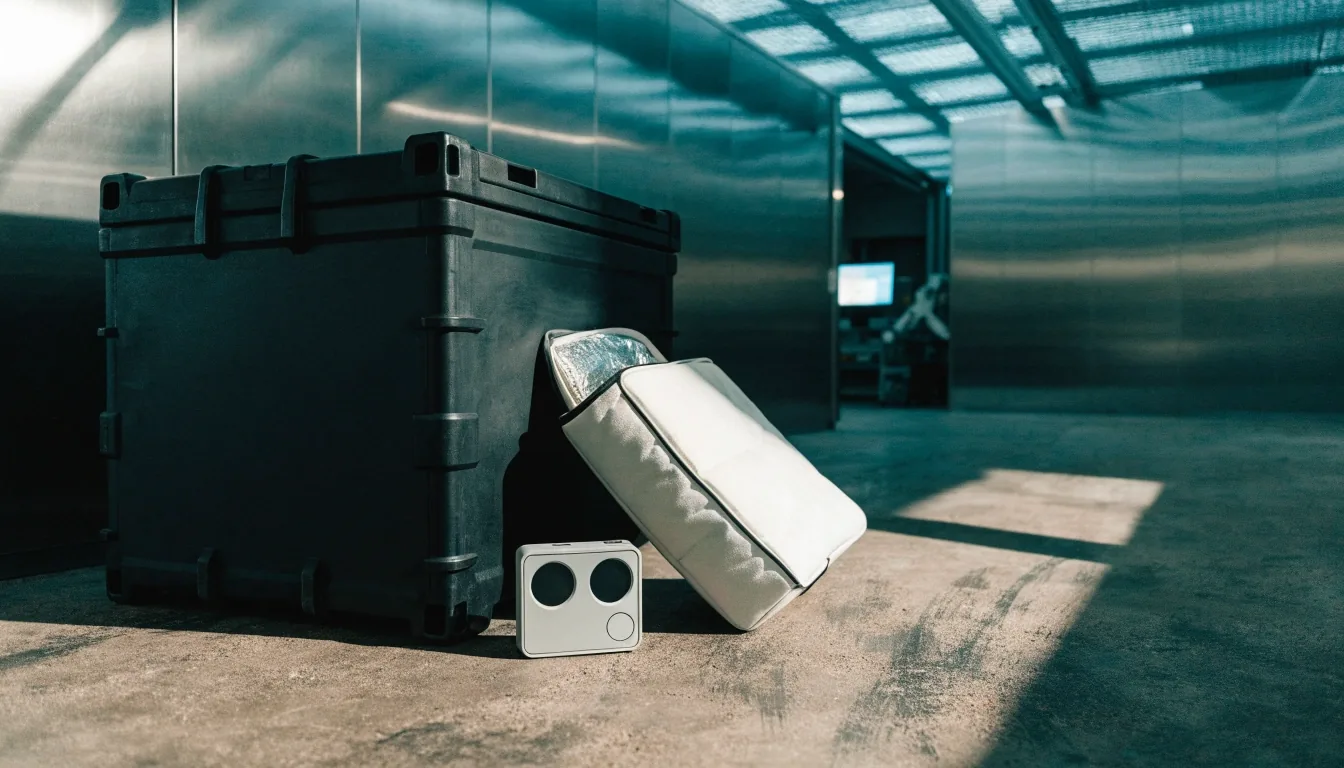
Zürich, Switzerland — manufacturing, validation, and B2B supply under one roof
Thermal Containers and Loggers for Pharmaceutical Cold Chain
Procurement teams, quality managers, and clinical logistics planners come to us because a shipment of insulin or blood test reagents has to arrive inside its validated temperature range, and somebody has to prove it. We build passive thermal containers, cooler bags, and temperature data loggers here, then document how each configuration performs before it leaves the facility.
A container that holds temperature in a test chamber still needs a documented qualification for your lane, payload mass, and seasonal ambient profile.
Three product families
What we manufacture in Switzerland
Our workshop and assembly site sit in the canton of Zürich, which keeps tooling, foam molding, and final validation in one supply chain instead of spread across subcontractors. Because we mold and assemble locally, a custom internal dimension or a different phase change setpoint is a production change rather than a sourcing project.
Compare product specifications-
Rigid containers
Pallet and parcel-scale thermal boxes
Vacuum insulated panels and molded EPS for longer durations, built to a fixed external footprint so they stack on standard pallets and fit parcel courier limits.
-
Cooler bags
Soft-sided carriers for last-mile routes
Reflective liners and conditioned phase change packs for clinical courier rounds, sized for a courier to carry on foot between a depot and a ward fridge.
-
Loggers
USB temperature data loggers
Single-use and reusable devices that record the journey, read once at destination or downloaded, reset, and reissued on recurring hospital loops.
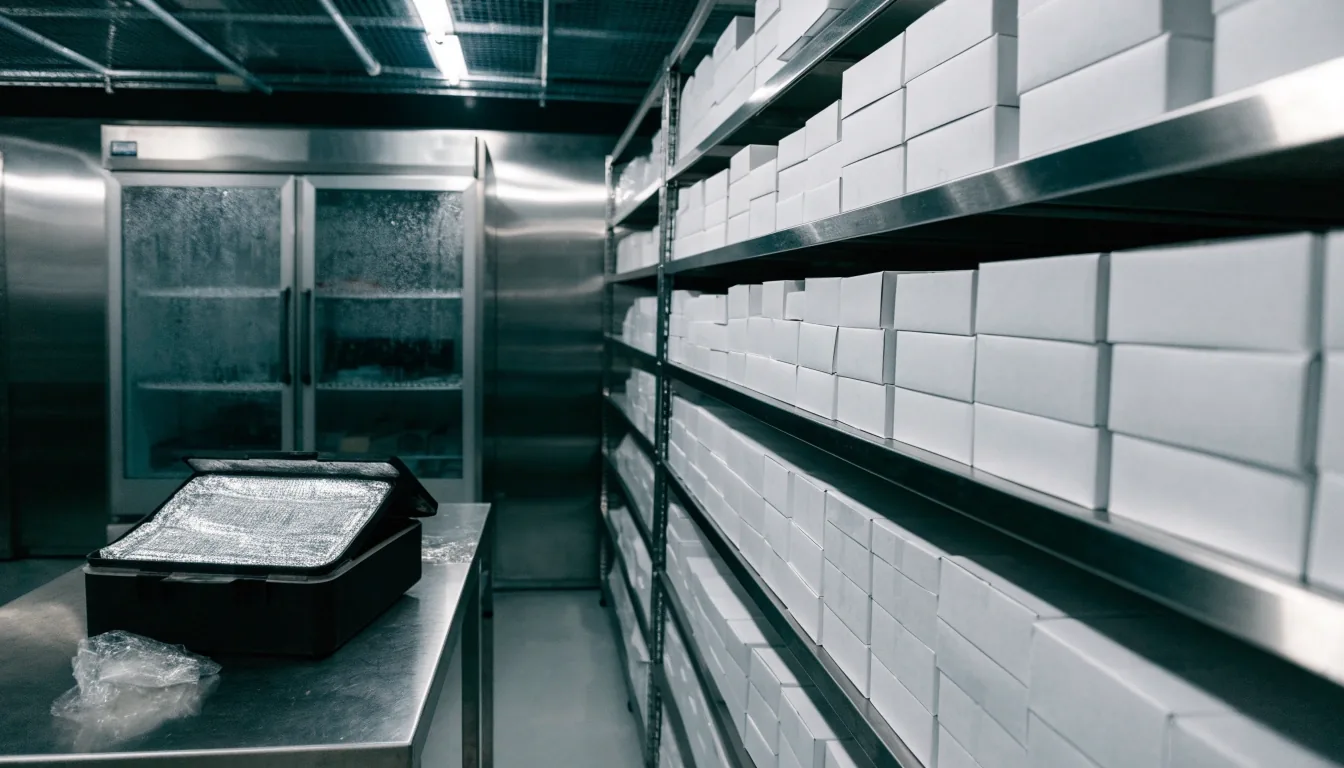
Lane fit before box size
Matching the container to the medicine
Insulin, monoclonal antibodies, blood test reagents, and clinical trial materials do not share the same temperature window. We ask for the product label range, the lane duration, and the expected ambient profile before quoting, because those three inputs decide the container class more than the box size does.
If you already run a qualified lane, we can work backwards from your existing data and match or exceed the documented hold time.
2 to 8 °C
Refrigerated lanes need their own insulation mass and phase change conditioning. Packs conditioned for a colder lane will push this payload below range.
15 to 25 °C
Controlled ambient routes lean on reflective liners and conditioned packs instead of heavy frozen mass, which keeps the payload inside a narrow band.
-20 °C
Frozen lanes carry their own qualification data. A refrigerated configuration cannot simply be run colder and expected to hold the same way.
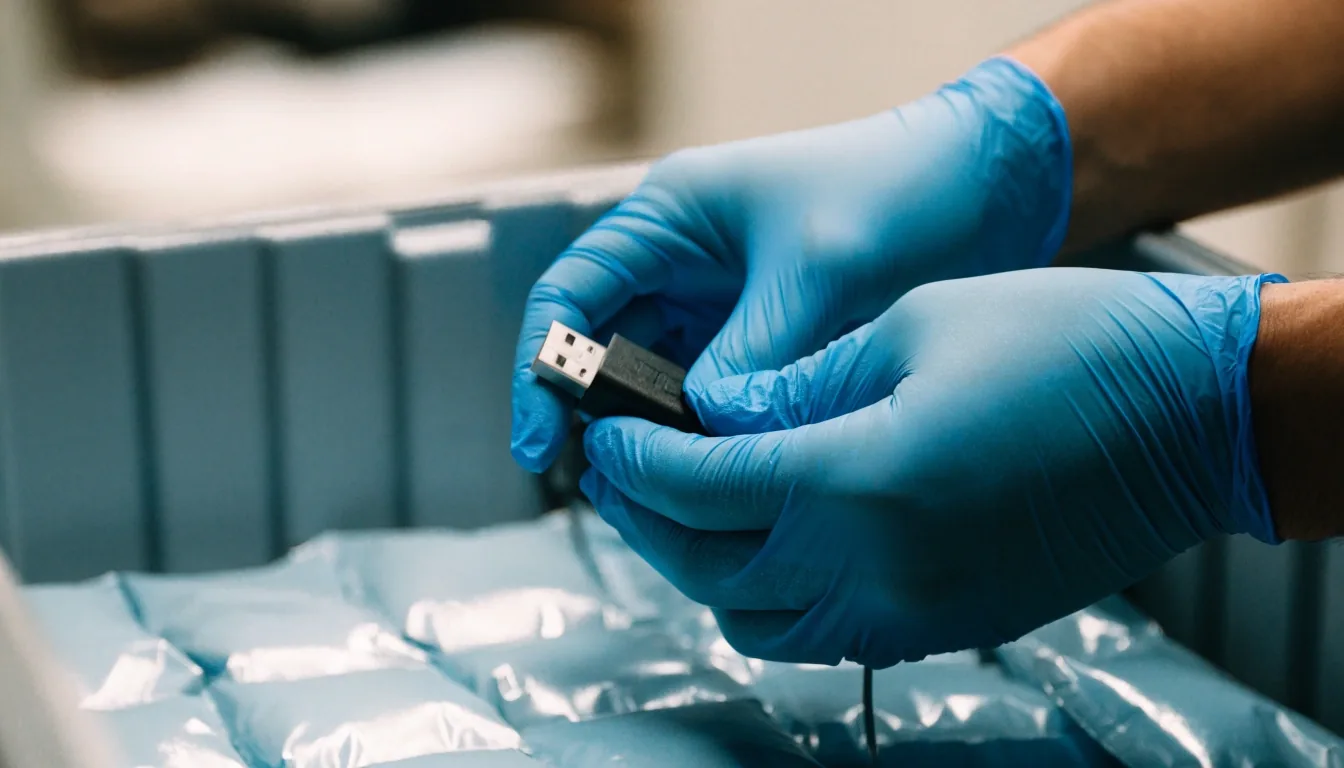
Temperature data loggers and what they record
Single-use units travel with the shipment and are read once at destination, which suits one-way clinical courier routes. Reusable loggers are downloaded, reset, and reissued, which suits recurring hospital delivery loops.
- Temperature only, for straightforward refrigerated and ambient lanes.
- Temperature and humidity, where condensation matters to the payload.
- Temperature, humidity, and shock, for fragile or high-value consignments.
Several models in the range are listed as compliant with GxP, FDA 21 CFR Part 11, and EN 12830, and some carry HACCP International listing. We state exactly which standard applies to the model you are considering, because the compliance profile differs across the family.
Conditioning instructions ship with every configuration
Phase change material and how conditioning works
A phase change pack is only useful if it is conditioned to the right state before packing. Conditioned to a fully frozen state, a pack designed for a refrigerated lane will push the payload below range. Conditioned correctly, it holds the container at its setpoint for the qualified duration.
Reusable packs are refilled and reconditioned at your site, which keeps recurring lane costs predictable and reduces single-use waste on high-volume routes. If your SOP requires a lane-specific qualification, we run one against your payload mass and ambient profile.
| Lane range | Conditioning state | If conditioned wrong |
|---|---|---|
| 2 to 8 °C refrigerated | Packs held at their designed setpoint, not frozen solid | Fully frozen packs drive the payload below the label range |
| 15 to 25 °C ambient | Packs charged to the ambient setpoint with reflective liners | Over-cooled packs pull the payload toward the refrigerated band |
| -20 °C frozen | Packs fully frozen to the qualified state before packing | Partially frozen packs shorten the qualified hold time |
Conditioning tables for each pack format are available with the product documentation. Tell us the lane and we will send the matching table.
Choosing between passive and active monitoring
A passive insulated container holds temperature through insulation and phase change material, with no power source. An active monitored solution adds a powered or networked device that reports while the shipment is in transit. Most pharmaceutical lanes we support run passive packaging with an independent logger, because it is simpler to qualify and produces a clean record at delivery.
Passive packaging with an independent logger
No power source in the box, one recorded file per shipment, and a qualification route that stays short. This is the usual choice for hospital deliveries, depot runs, and diagnostic lab routes where you need documented evidence after arrival.
- Simpler to qualify and repeat on a fixed schedule
- Nothing to charge, pair, or recover after delivery
- Record available at the destination, not only afterwards
Active monitoring in transit
A powered or networked device reports while the shipment moves. It makes sense when a lane is long, high-value, or crosses several handling points and you want a deviation flagged before the consignment arrives rather than explained after it.
- Earlier warning on a multi-leg or cross-border route
- Useful for high-value clinical trial material
- Needs recovery, charging, and its own procedures
We supply both, and the choice usually comes down to whether you need to know during transit or only need documented evidence afterwards.
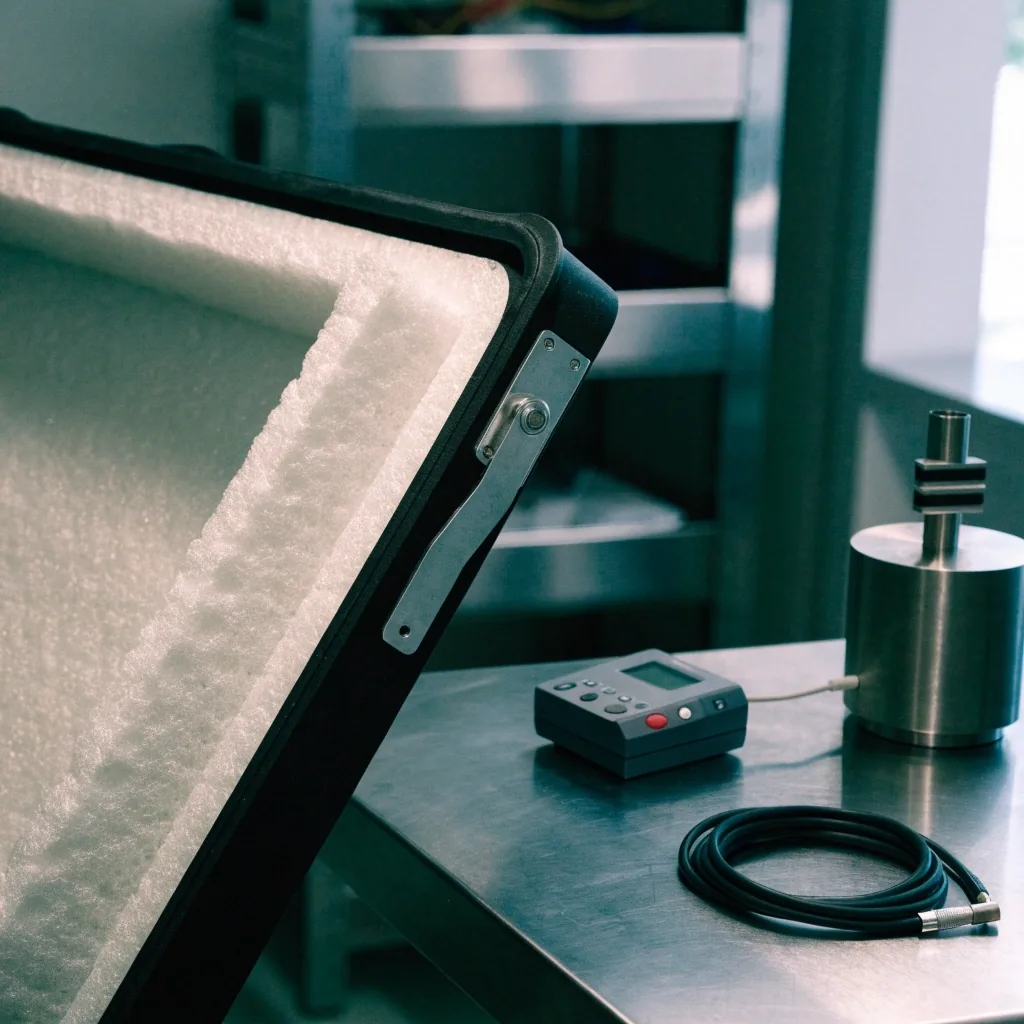
Standards that appear on our documents
Our quality file references ISO 9001 for the quality management system and ISO 14001 for environmental management. Transport logger specifications cite GxP, FDA 21 CFR Part 11, and EN 12830 where applicable, since EN 12830 is the standard buyers use to compare temperature recorder claims in transport. HACCP International listing appears on models that also serve food logistics.
Regulatory expectations in Europe trace back to EU GDP principles, and MHRA guidance is a common benchmark that quality teams cite when they write their own transport validation. We publish certificate numbers and scopes on the Quality & Certifications page so an auditor can verify them without emailing us.
See quality certificates- ISO 9001
- Quality management system covering design, molding, assembly, and final validation at the Zürich site.
- ISO 14001
- Environmental management, relevant to reusable container fleets and pack reconditioning at customer sites.
- GxP and 21 CFR Part 11
- Cited on logger datasheets where the model carries the required records and access controls.
- EN 12830
- The comparison standard buyers use for temperature recorders in transport. Applied per model, not across the range.
- HACCP International
- Listing carried by models that also serve food logistics alongside pharmaceutical lanes.
Validation and qualification support
Qualification is the part most buyers underestimate. A container that holds temperature in our test chamber still needs a documented qualification for your specific lane, payload mass, and seasonal ambient profile. Reusable containers are qualified once and re-qualified on a defined interval; single-use systems are qualified by batch or by configuration.
-
Thermal mapping data
Where the container holds temperature and where it runs warmest, so you can see whether your payload position is covered.
-
Container qualification reports
Written against your lane duration and ambient profile, ready to drop into an audit file alongside the logger record.
-
Logger calibration certificates
Issued per device or per batch, so the measurement itself is traceable and not just the packaging around it.
-
Live lane studies
If your SOP requires one, we supply the packaging and loggers and review the resulting data with your quality team.
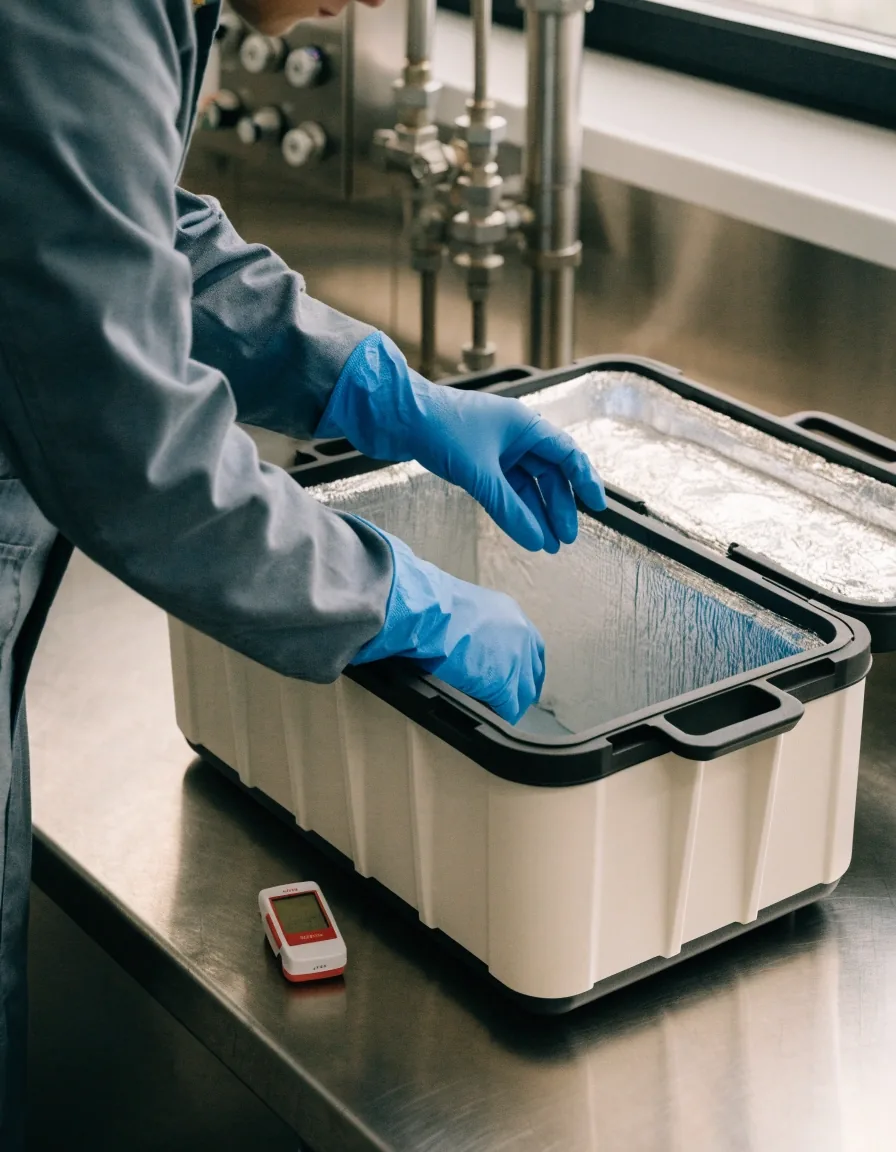
Qualification work happens on the same site where the containers are molded and assembled, which shortens the loop between a question and a documented answer.
B2B delivery terms
We ship across Switzerland and the wider EU from our Zürich facility. Standard B2B terms are ex-works or delivered duty paid depending on volume and destination, with pallet and parcel options for both. Reusable container fleets can be supplied on a recurring schedule so your wards and depots are not short during a seasonal peak.
Lead times depend on whether the configuration is catalog or custom, and we confirm them in writing at order acknowledgement. For cross-border lanes we handle the export documentation and can align delivery windows with your courier's collection schedule.
Dispatch and contact
- Facility and registered address
- Industriestrasse 42, 8304 Wallisellen, Switzerland
- Order desk
- +41 44 885 80 31
- [email protected]
- Working hours
- Monday to Friday, 08:00–17:30 (CET)
Who we work with
Our customers are pharmaceutical manufacturers, hospital pharmacy departments, clinical trial sponsors, diagnostic laboratories, and third-party logistics providers that handle healthcare freight. They share one requirement: the shipment must arrive in range and the record must survive an audit.
Some come to us with a fully written validation protocol and need packaging that meets it. Others need help writing the protocol in the first place. Both are normal. We would rather ask four questions up front than ship a container that fails its first lane.
- Pharmaceutical manufacturers
- Hospital pharmacy departments
- Clinical trial sponsors
- Diagnostic laboratories
- Healthcare freight and 3PL providers
Swiss legal compliance and entity details
ThermoVault Pharma Logistics AG is registered in Switzerland, and our full legal form, UID number, registered address, and commercial register entry are published on the Impressum page. Swiss company law requires those details to be visible, and we keep them current. Data handling for this website and for quote requests is described in the Privacy Policy, with cookie usage detailed separately.
If your procurement department needs a signed supplier declaration, a tax residency certificate, or a bank confirmation, our administrative team issues those on request.
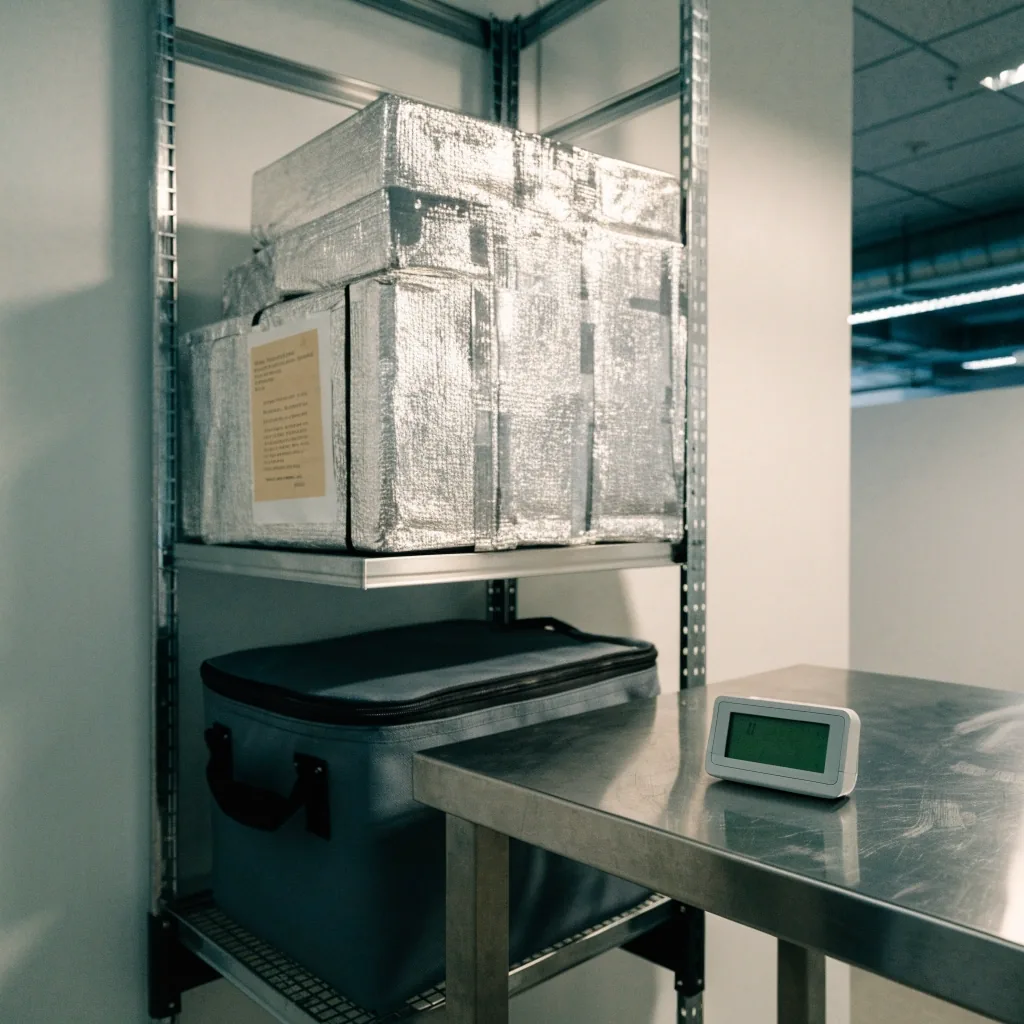
Documentation you can download or request
Material specification sheets, container dimension drawings, phase change conditioning tables, logger datasheets, ISO certificates, and calibration certificates are available for every catalog product. Some are published directly on the product and quality pages. Others, including lane-specific qualification reports, we send after a short technical call so we can match the document to your actual lane instead of a generic example.
Published on the site
- Material specification sheets
- Container dimension drawings
- Logger datasheets with applicable standards
- ISO 9001 and ISO 14001 certificate scopes
Sent after a technical call
- Lane-specific qualification reports
- Thermal mapping data for your configuration
- Calibration certificates for your logger batch
- PCM conditioning tables matched to your setpoint
Tell us the product, the lane, and the duration, and we will send the smallest set of documents that answers your question.
Questions we answer before a first order
These are the five questions procurement and quality teams ask most often. If yours is not here, the order desk answers it in writing.
Do you supply both single-use and reusable cold-chain packaging?
Yes. Single-use containers and loggers suit one-way clinical courier routes, while reusable containers and loggers suit recurring hospital and depot delivery loops. We quote both so you can compare total cost per lane.
Which temperature ranges can you cover?
We build configurations for refrigerated lanes around 2 to 8 °C, controlled ambient lanes around 15 to 25 °C, and frozen lanes around -20 °C. The exact hold time depends on payload mass, ambient profile, and duration, which is why we ask for lane details before quoting.
Can you provide ISO certificates and validation documents for an audit?
Yes. ISO 9001 and ISO 14001 certificates, logger datasheets, container qualification reports, and calibration certificates are available on request. Certificate scopes and numbers are listed on our Quality & Certifications page.
How do B2B delivery terms work for customers outside Switzerland?
We ship from Zürich across the EU on ex-works or delivered duty paid terms, depending on volume and destination. Export documentation is handled on our side, and delivery windows can be aligned with your courier's collection schedule.
Do your loggers meet GxP and FDA 21 CFR Part 11 requirements?
Several models in our logger range are listed as compliant with GxP, FDA 21 CFR Part 11, and EN 12830, and some also carry HACCP International listing. The applicable standards differ by model, so we confirm the exact compliance profile for the device you select.
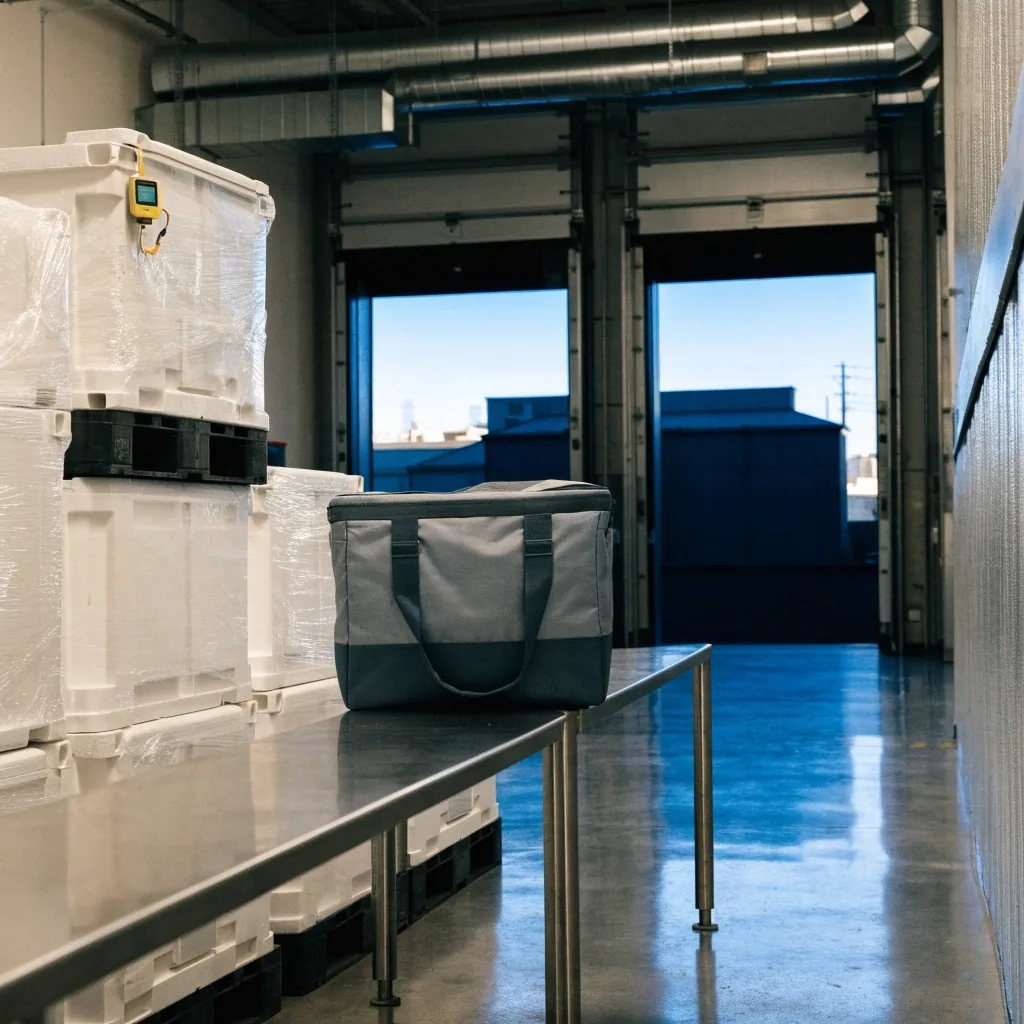
Getting a quote
A usable quote needs four things: the temperature range, the lane duration, the shipment volume per month, and whether you want reusable or single-use packaging. With those, we can name a container class, a logger model, and a delivery schedule. Without them, we will ask, because guessing produces quotes that change later.
Send the details through the quote form and a cold-chain specialist replies with a configuration proposal and the relevant certificates attached.